
Online Tuition vs Home Tuition: 5 Differences That Matter
Online tuition vs home tuition is one of the first questions parents ask City Home Tutors. Both work well. The better choice depends on your child, your city and the subject, so here is a fair comparison with five differences that actually matter.
By City Home Tutors. Published 4 November 2026. 4 min read.
Online Tuition vs Home Tuition: The Short Answer
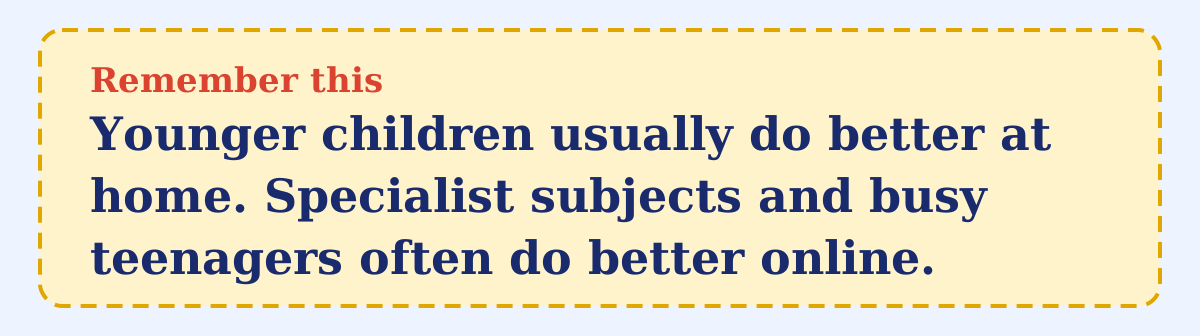
Neither is better for everyone. Home tuition suits younger children, hands-on subjects and families who like a tutor in the room. Online tuition suits specialist subjects, busy teenagers and families outside the big cities. Many families use both at different times of the year.
1. Focus and Attention
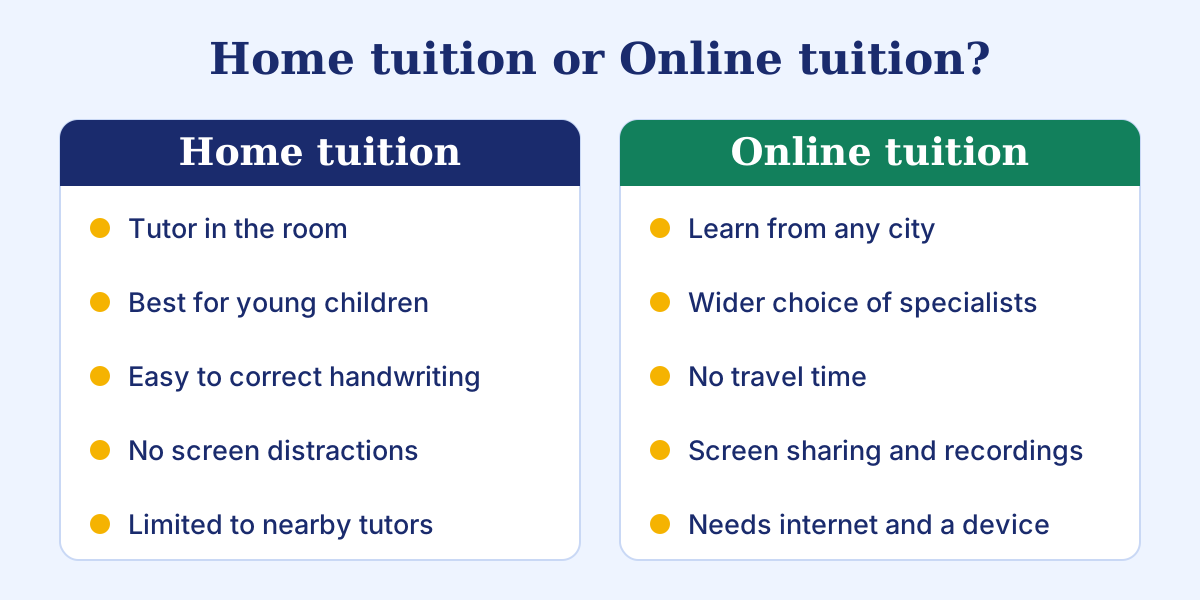
At home, the tutor sits next to your child and can see when attention drifts, so it is easier to bring them back. Online, the screen can be a distraction: other tabs, notifications, a phone nearby.
Older students who are used to studying on a laptop usually manage fine. For children in primary or middle school, a tutor in the room makes a real difference. See the primary tutors and middle school tutors.
2. Choice of Tutor
This is where online has the biggest advantage. A home tutor must live or work within reach of your area. An online tutor can be anywhere in the country, so you can pick the best match for your subject.
That matters most for specialist subjects such as A Level Chemistry, Further Maths or entry tests like MDCAT, where good tutors are few. It also helps families in smaller cities, who can learn with the same tutors as students in Lahore or Karachi. Start with the online tutors in Pakistan.
3. Time and Travel
Online lessons save the commute for both sides, so evening and weekend slots are easier to find. Home lessons need the tutor to travel, which in big cities can mean traffic, late arrivals and fewer available hours.
If your child is already busy with school, sports and Quran classes, the extra hour saved can decide whether tutoring is sustainable.
4. Teaching Tools and Material
Online tutors can share their screen, use a digital whiteboard, display past papers and send worked solutions straight away. Some lessons can be recorded for revision, if both sides agree.
Home tutors use pen and paper, which many students find easier for diagrams, geometry and handwriting practice. For subjects with lots of working, such as maths and physics, a tablet with a pen closes much of the gap online.
5. What It Takes From You
Home tuition needs a quiet space, and for younger children a family member at home. Online tuition needs a stable internet connection, a laptop or tablet, headphones and a quiet corner. If power cuts or weak internet are a problem in your area, home lessons are safer.
What a Good Online Lesson Looks Like
An online lesson is not just a video call with a textbook. A good one has a clear shape that you can check for in the first demo class:
- The tutor starts by asking what was covered at school this week and what homework is pending.
- Explanations use a shared screen, whiteboard or photo of the student's own notebook, not only talking.
- The student does the working out, on paper, while the tutor watches and corrects.
- The lesson ends with two or three questions to try alone and a note of what comes next.
If your child spends most of the hour just listening, the lesson is not working, whether it is online or at home. Ask the tutor to make the lesson more hands-on.
Common Mistakes Families Make
- Choosing online only because it is cheaper or easier. A format that does not suit your child will cost more in lost progress than it saves.
- Letting a young child manage online lessons alone. Be nearby for the first few weeks, check the device is set up and make sure the lesson starts on time.
- Ignoring the internet. Frequent drop-outs make lessons frustrating. Test your connection at the lesson time, and if it is unreliable, compare providers and report faults to the Pakistan Telecommunication Authority (PTA).
- Switching formats too often. Give either format at least a month before you judge it.
Can You Mix Both?
Yes, and many families do. A common pattern is home lessons for the core subject throughout the year, with online sessions for a specialist subject or extra exam practice before the board exams. Another is to start online with a great tutor and add a home tutor later for a younger sibling.
How to Decide in Three Questions
- Can my child concentrate on a screen for an hour?
- Is there a good tutor for this subject near us?
- Do we have a device and a stable internet connection?
If the answers are yes, try an online tutor. If not, find a home tutor in your city, for example Lahore, Karachi or Islamabad. Either way, the first class is free, so you can try before you decide.

Request a tutor on WhatsApp Call 0302 9366481
More Guides
Questions Parents Ask
Is online tuition as effective as home tuition?
It can be, especially for older students who can focus on a screen. Effectiveness depends more on the tutor and your child's engagement than on the format.
What do I need for online lessons?
A stable internet connection, a laptop, tablet or phone, headphones and a quiet place. A notebook and pen are still useful.
Can my child switch between online and home tuition?
Yes. Message City Home Tutors and the team finds a tutor for the other format, for the same class and subject.
Which is better for board exam preparation?
Both work. Many students use home lessons for steady learning and add online sessions for past papers and mock tests close to the exams.