
How to Prepare for MDCAT: A Simple 7-Step Study Plan
Knowing how to prepare for MDCAT starts with one idea: steady practice beats last-minute cramming. This 7-step plan gives you a weekly routine that builds concepts first, then speed, without burning you out.
By City Home Tutors. Published 4 November 2026. 4 min read.

How to Prepare for MDCAT: Why a Plan Matters
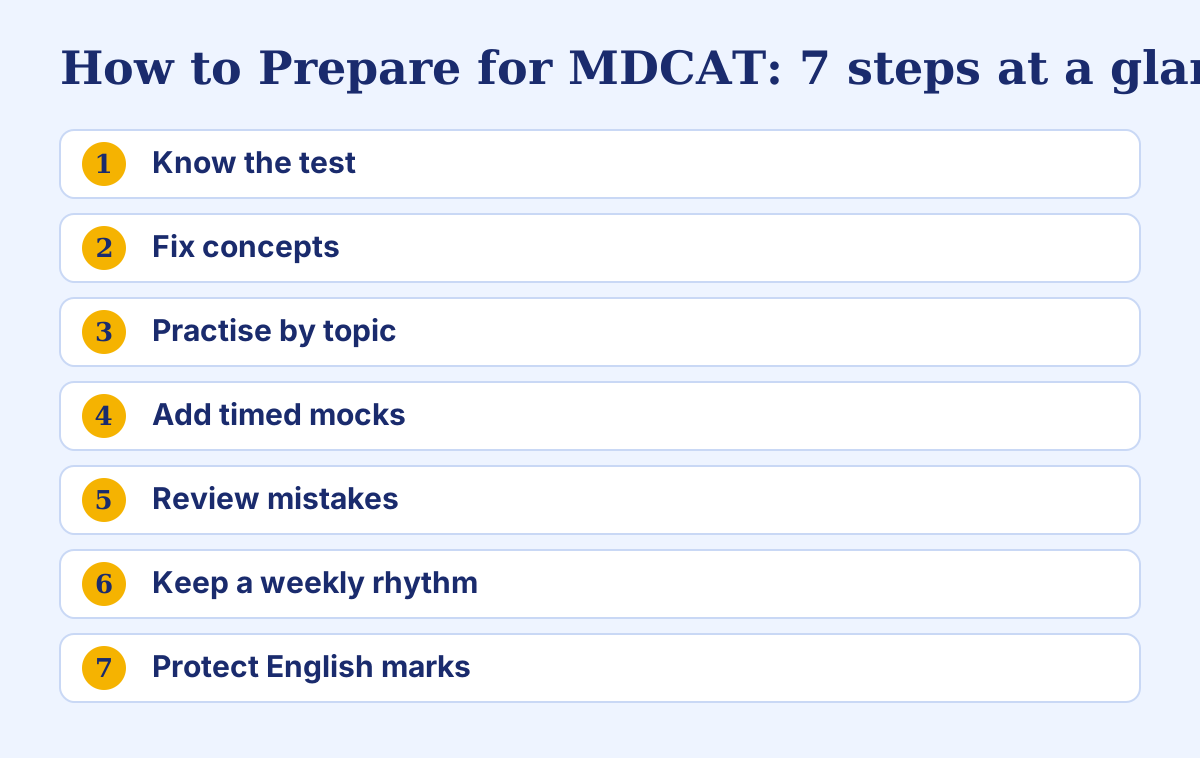
MDCAT is a long MCQ test covering biology, chemistry, physics and English. Students who do well rarely study the longest hours. They study in a clear order: understand a topic, practise it, test themselves under time, then learn from the mistakes. The seven steps below follow that order.
1. Know the Test
MDCAT is conducted by the Pakistan Medical and Dental Council (PMDC). Format, syllabus, dates and rules can change from year to year, so always check the latest official notices on the PMDC website before you plan. Do not rely on a friend's notes from last year without comparing them with the current syllabus.
2. Fix Concepts Before You Drill
MCQs punish half-understood ideas. A wrong option is often written to look right to someone who has only memorised a line. Go through each FSc chapter and make sure you can explain it in your own words before you start heavy practice.
A simple test: close the book and explain the chapter to a friend or family member in two minutes. Where you stumble is where you revise next. The biology, chemistry and physics tutors at City Home Tutors can help with the chapters that feel hardest.
3. Practise MCQs by Topic
After each chapter, solve topic-wise MCQs while the material is fresh. Keep a notebook of every wrong answer and write the reason for the mistake:
- Concept gap: I did not understand the idea.
- Fact gap: I forgot a definition, value or name.
- Careless error: I misread the question or the options.
Each type needs a different fix, so naming it matters.
4. Add Timed Mock Tests
From about halfway through your preparation, sit full-length mocks under exam conditions: same duration, no phone, no breaks beyond what the exam allows. Speed and stamina are skills you can train.
Practise skipping a hard question and coming back to it. Many students lose marks by spending far too long on a few difficult items. Check the official rules on negative marking before you decide how much to guess.

5. Review Every Mock Carefully
The review is worth more than the score. Go through every wrong answer and every answer you guessed correctly. Most students find their mistakes cluster in a few topics, and those topics become your plan for the next week.
6. Keep a Weekly Rhythm
A repeating week is easier to sustain than a heroic one. Here is a simple pattern:
- Four days: learn new topics, then do topic-wise MCQs.
- One day: revise your mistake notebook from the week.
- One day: sit a mock or half-mock, then review it.
- One day: rest. Sleep and breaks help memory.
Adjust the pattern around your college timetable and exam dates. In the last weeks, increase mocks and reduce new material.
7. Don't Ignore English
English marks are among the easiest to protect. Read a little every day, such as an article or a few pages of a book, and practise the question types: vocabulary, grammar and comprehension. Even fifteen minutes a day adds up over months. An English tutor can help if this is a weak area.
Common MDCAT Mistakes to Avoid
- Collecting resources instead of using them. One good book and one question bank, finished properly, beat five half-used ones.
- Skipping weak topics. It feels comfortable to revise what you already know. Start each week with the topic you like least.
- Studying only with notes. Reading feels productive, but testing yourself is what builds recall. Close the book and answer from memory.
- Taking mocks too late. A mock three days before the test shows you problems you no longer have time to fix. Start earlier and repeat often.
- Neglecting sleep and rest. Tired students make careless errors. A rest day each week is part of the plan, not a reward.
A Sample Week, Hour by Hour
If you can give about four hours on a college day, one balanced split is: an hour and a half on a new topic, an hour on topic MCQs, forty-five minutes revising mistakes from the notebook, and the rest on English or a past topic. On weekends, replace one block with a mock. Move the pieces around to match your college hours, but keep the order: learn, practise, test, review.
When a Tutor Helps
A tutor who has sat the test can find your weak topics quickly, build a plan around your FSc timetable and mark your mocks honestly. Online lessons work well for mock-test review, especially for students outside the big cities. See the MDCAT tutors or online MDCAT tutors, or send a request.

Request a tutor on WhatsApp Call 0302 9366481
More Guides
Questions Parents Ask
When should I start preparing for MDCAT?
Many students begin in first year of FSc and increase the intensity in second year. Starting early with concepts makes the final months much easier.
How many hours a day should I study?
It depends on your timetable. Consistent daily study with a weekly rest day is more useful than irregular long sessions.
Are mock tests really necessary?
Yes. They train speed, stamina and exam nerves, and show you which topics need work.
Can I prepare for MDCAT online?
Yes. Many students use live online lessons with shared screen, topic MCQs and mock-test reviews.