
How to Choose a Home Tutor: 7 Checks Before You Hire
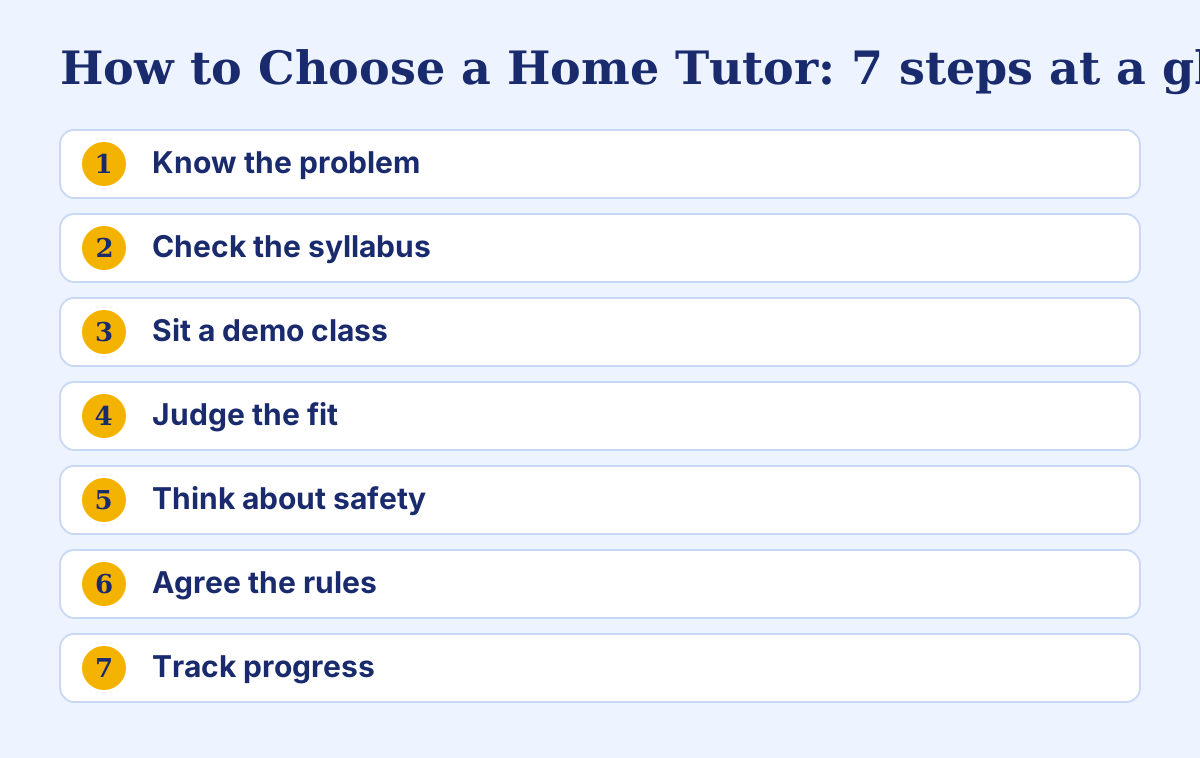
Knowing how to choose a home tutor is the difference between a child who starts to enjoy a subject and a few wasted months. This guide gives you seven checks to run before you hire anyone, plus the red flags that tell you to walk away.
By City Home Tutors. Published 4 November 2026. 4 min read.

How to Choose a Home Tutor: Start with Your Child, Not the Tutor
Before you speak to a single tutor, write down what is actually going wrong. "Weak in maths" is too wide to act on. "Understands the lesson but loses marks in algebra and word problems" is something a tutor can fix.
Note the class, the board (Matric, Cambridge, Edexcel or FSc), the next exam date, and your child's mood about the subject. A shy child needs a different tutor from a confident one who is simply bored. These few lines make every conversation after this much shorter.
1. Check Subject Knowledge and Syllabus, Not Only the Degree
A degree shows the tutor studied the subject. It does not show they can teach your child's syllabus. A Matric board paper, a Cambridge O Level paper and an FSc paper ask different kinds of questions, even in the same subject.
Ask which papers the tutor has taught, which past papers they use, and how they would plan the next three months. For Cambridge subjects, the official Cambridge International site lists the syllabus and past papers, so you can see what your child must cover and ask the tutor about it.
2. Always Insist on a Demo Class
A profile can tell you a lot, but a demo class tells you more. Sit nearby for the first lesson and watch three things:
- Does the tutor ask your child questions, or just talk?
- Does your child understand the explanation, and say so out loud?
- Does the tutor ask to see school notebooks and recent test marks first?
A tutor who starts by finding out where your child is stuck is usually better than one who opens the book and begins at chapter one. At City Home Tutors the demo class is free, so you can compare before you commit.
3. Look for Patience and Clear Explanation
Children learn best from tutors they feel comfortable with. Notice how the tutor reacts when your child gets something wrong. A tutor who says "let me explain that another way" is worth more than one with a famous name who sighs.
Ask your child after the demo: "Did you understand? Would you want to learn with this person again?" Their answer matters more than any certificate on the wall.
4. Think About Safety and Comfort at Home
Home lessons work best when the whole family is relaxed about them. A few simple habits help:
- Have a parent or family member at home during lessons, especially for younger children.
- Choose a shared space such as a lounge or dining room, not a closed bedroom.
- Ask City Home Tutors for a male or female tutor if that makes your family more comfortable.
- Meet the tutor briefly before the first lesson, and confirm who is coming and when.
If a tutor resists any of these, that is information too.
5. Agree the Schedule, Fee and Rules at the Start
Most tutor-family problems are really misunderstandings about time and money. Settle these in the first conversation:
- Days, times and how long each lesson lasts.
- The monthly fee and when it is paid.
- What happens when a lesson is missed or rescheduled, by either side.
- Who arranges the practice papers and notes.
Write it in a WhatsApp message so both sides can look back at it.
6. Ask How Progress Will Be Tracked
A good tutor sets small goals instead of promising miracles. Look for a simple rhythm like this:
- A short topic test every week or two.
- Homework that is checked and corrected, not just set.
- A brief update to parents after each month, with test marks and next steps.
Compare the first test result with the third. If the marks and your child's confidence are both moving up, the tutoring is working.

7. Give It Time, and Know When to Change
Confidence and marks rarely change in a week. Give a new tutor four to six weeks. Then ask: Is my child more willing to open the book? Are test marks improving? Does the tutor have a plan for the weak topics?
If the answers are no and the tutor has no plan, it is fair to change. Tell City Home Tutors, and the team will find another tutor without an awkward conversation.
Red Flags to Watch for
- The tutor promises a specific grade or marks.
- No questions are asked about your child's current level.
- Lessons are repeatedly late, cancelled or cut short.
- The tutor talks for the whole lesson and your child never speaks.
- The tutor discourages parents from knowing about progress.
Questions to Ask in the First Call
- Which classes and boards have you taught?
- What will you do in the first two weeks?
- How will I know my child is improving?
- What is your policy on missed lessons?
- Can I sit in on the demo class?
Ready to find one? See home tutors in Lahore, Karachi or Islamabad, or send a request and City Home Tutors will suggest tutors who fit.

Request a tutor on WhatsApp Call 0302 9366481
More Guides
Questions Parents Ask
How many tutors should I meet before choosing one?
Two or three is usually enough. More than that and the choice gets harder, not easier. Compare them on how your child responds in the demo class.
Should I choose a tutor with more experience or a younger one?
Experience helps with exam technique, while younger tutors such as university students are often closer to what your child is going through. Fit and clear explanation matter more than age.
How long before I see improvement?
Often four to six weeks for confidence and homework habits, and a full term for test marks. Ask the tutor for small, measurable goals along the way.
Is a home tutor better than a tuition centre?
A home tutor gives one-to-one attention and a flexible schedule. A centre offers a classroom setting. Many families choose based on how their child learns best.