
O Level vs Matric: 6 Differences Every Parent Should Know
O Level vs Matric is a big decision for many families, and it often comes with strong opinions from relatives. There is no single right answer, but knowing the six differences below will help you support your child on either path.
By City Home Tutors. Published 4 November 2026. 5 min read.
O Level vs Matric: The Basics
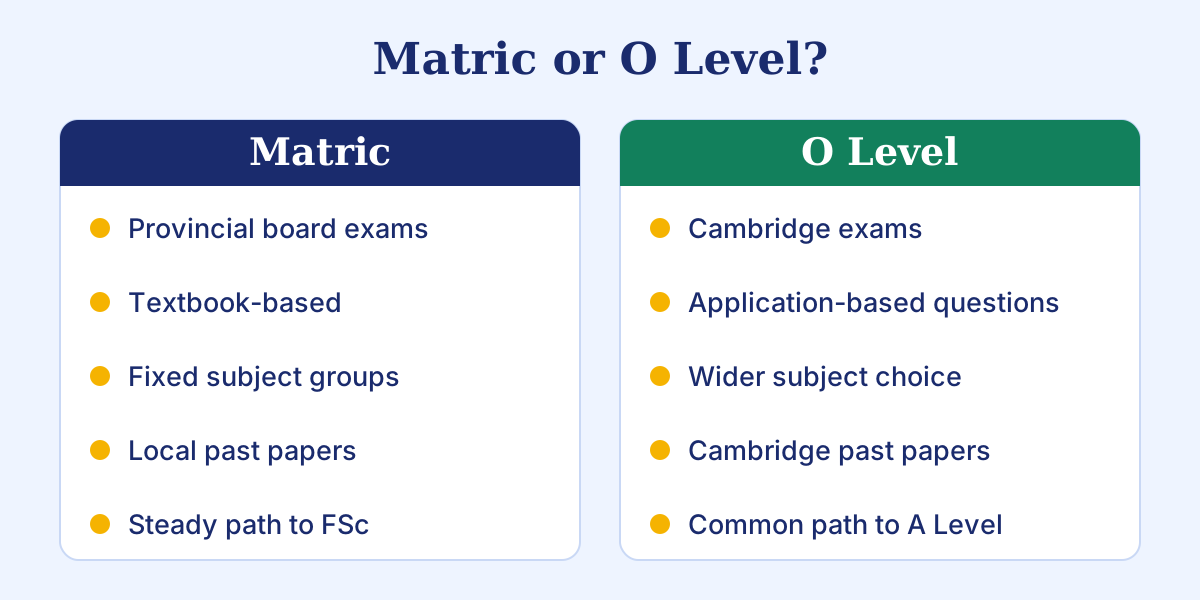
Matric is Pakistan's board system, with exams set by provincial boards such as those in Punjab, Sindh and Khyber Pakhtunkhwa. O Level is a Cambridge qualification, sat in Pakistan through approved centres. Both lead on to higher study: FSc for most Matric students and A Level for most O Level students.
1. How the Exams Feel
Matric leans heavily on the textbook. Many questions can be answered well with carefully learned notes and exact definitions. O Level papers ask students to apply what they know to new situations, so understanding matters more than memorising.
For a child moving from one to the other, the change in question style is often a bigger shock than the content. Practising past papers early is the best fix. The Matric tutors and O Level tutors at City Home Tutors teach paper by paper.
2. Subjects on Offer
Matric usually offers fixed groups, such as science or arts. O Level lets students choose a wider mix, for example Accounting, Economics, Computer Science or Business Studies. This flexibility suits students who already know which direction they want to go.
3. Language Demands
Both can be taught in English, but O Level papers expect clearer written English even in science and maths, because answers must be explained in sentences. A child whose English is weak should get support early, for example from an English tutor.
4. Past Papers and Preparation
For O Level, Cambridge publishes past papers and mark schemes that students and tutors use heavily. The Cambridge International site is the official place to check the current syllabus for each subject.
For Matric, the relevant board's own past papers and textbook are the main material. In both systems, timed practice with a mark scheme is the most useful form of revision.
5. What Comes After
Matric students usually go on to FSc or ICS, and from there to university entry tests. O Level students usually continue to A Level. O Level and A Level students often need an equivalence certificate for admission to Pakistani universities. Check the current rules with the Inter Board Committee of Chairmen (IBCC) before you plan the switch.

6. Tutoring Is Different Too
A Matric tutor works from the board textbook and board past papers. An O Level tutor works from the Cambridge syllabus and papers, often by topic and paper number. When you request a tutor, share which system your child follows, so City Home Tutors can match someone who has taught that exact paper.
How to Help Your Child Settle Into Either System
Whichever path you choose, the first term decides a lot. A few habits help in both systems:
- Get the syllabus and a past paper in the first month, so your child sees what the exam really looks like.
- Build a weekly routine for each subject, with one short timed practice session rather than one long cramming day.
- Ask for feedback on written answers. Many students lose marks not from lack of knowledge but from how they write the answer.
- Read in English every day, a news article or a chapter of a book, to build vocabulary that exam questions rely on.
If your child is stuck in one subject, a tutor who knows that exact paper can close the gap in a few weeks instead of a few months. The mathematics, chemistry and physics tutors at City Home Tutors teach both systems.
Mistakes Parents Make When Comparing the Two
- Choosing by prestige. A system that suits one child can frustrate another. Look at how your child learns, not at what the neighbours chose.
- Waiting too long to switch. If you are going to move from Matric to O Level (or the reverse), the start of Class 9 is much easier than the middle of Class 10.
- Ignoring the cost of preparation. O Level exams, books and registration cost more, and students often need extra practice material. Plan for it early.
- Not asking the school. Some schools prepare students for one system only. Ask what support they give for exam technique and past papers.
A Quick Way to Think About It
Ask three plain questions at home. What does my child want to study after school? Do they do better when told exactly what to learn, or when asked to work things out? And how comfortable are they writing answers in English? The answers will usually point towards one path, and a good school counsellor or tutor can confirm it.
So Which Should You Choose?
Let your child's school, future plans and learning style lead:
- If the family may study abroad or your child wants a wide subject choice, O Level is a common route.
- If the plan is FSc and entry tests in Pakistan, Matric is a steady path.
- If your child learns best from structured notes, Matric may feel more comfortable. If they enjoy problem solving, O Level may suit them.
Neither is easier. Both reward steady work. If you are unsure, talk to your child's school and to a tutor who has taught both.
Need help with either? See Matric tutors, O Level tutors, or send a request.

Request a tutor on WhatsApp Call 0302 9366481
More Guides
Questions Parents Ask
Is O Level harder than Matric?
The content is similar in many subjects, but O Level asks for more application and clearer written answers. Students who prepare well do well in both.
Can my child move from Matric to O Level?
Yes, but it is easier at the start of Class 9. Moving later needs extra support to adjust to the question style.
Which one is better for university admission?
Both are accepted. If you move between systems, check equivalence requirements with IBCC and your target university.
Do I need a tutor for O Level?
Not always, but many students benefit from one for the subjects they find hardest, especially maths and sciences.